

Every California Agency Needs a Conflict of Interest Code
The Political Reform Act requires every state and local government agency in California to adopt a conflict of interest code. The code is the document that translates the law into your org chart: it lists the designated positions whose duties involve making or participating in decisions that could affect personal financial interests, and it assigns each position disclosure categories that define what the person in that position must report on their Form 700 Statement of Economic Interests.
Officials listed in Government Code Section 87200 — council members, supervisors, planning commissioners, city managers, attorneys, treasurers — file full disclosure under the statute itself. Everyone else who files Form 700 does so because their position is designated in an agency's conflict of interest code. That makes the code the single source of truth for who files, and what they disclose.
The Biennial Review: Every Even-Numbered Year
Agencies can't just adopt a code and forget it. In every even-numbered year, each local agency must review its conflict of interest code and notify its code reviewing body whether the code needs amending — typically by October 1. For city agencies the code reviewing body is the city council. For county agencies and agencies wholly within one county — including single-county special districts and joint powers authorities (JPAs) — it's the board of supervisors. The FPPC reviews the codes of state agencies and multi-county agencies, including special districts and JPAs whose jurisdiction spans more than one county.
Amendments are needed whenever positions are created, eliminated, or renamed, when duties change, or when disclosure categories no longer match reality. In practice, the biennial review is where paper-based agencies discover their filer list, their code, and their org chart have quietly drifted apart — usually in the middle of a deadline.
How eFile helps
Your code and your filers, always in sync.
- Built-in Conflict of Interest Code management — positions and disclosure categories live with your filer database.
- Form 700 assignments generated directly from the code, so nobody falls through the cracks.
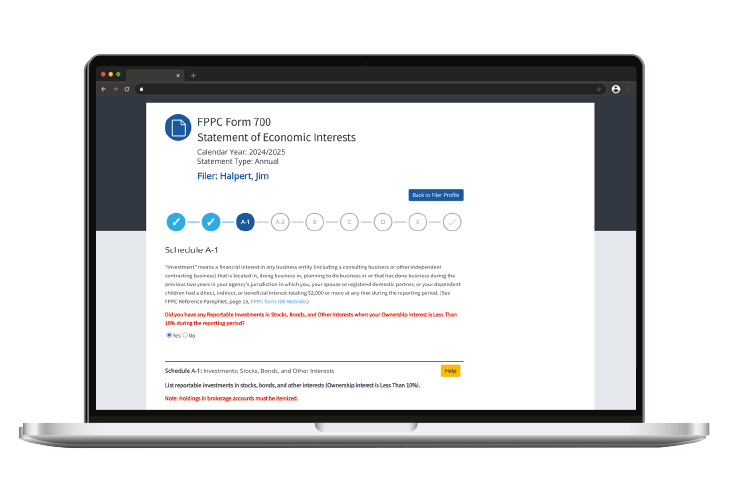
- Filers only see the schedules their disclosure category requires.
- Position changes are tracked, making the biennial review a report instead of a project.
- Optional formal code amendment workflow, with agency attorney review and approval steps built in.
- New designated employees are automatically assigned assuming-office statements.
Frequently Asked Questions
What is a conflict of interest code?
Under the Political Reform Act, every California state and local agency must adopt a conflict of interest code. The code designates the positions in the agency whose duties involve decisions that could affect personal financial interests, and assigns each designated position disclosure categories that determine what the position holder must report on Form 700.
What is the biennial review of a conflict of interest code?
Every local agency must review its conflict of interest code in each even-numbered year and notify its code reviewing body whether amendments are needed — typically by October 1 of that year. Codes are amended when positions are created, eliminated, renamed, or when duties change.
Who is the code reviewing body for a local agency?
For city agencies, the city council is the code reviewing body. For county agencies and agencies wholly within one county — including single-county special districts and JPAs — it is the county board of supervisors. The FPPC is the code reviewing body for state agencies and multi-county agencies, including special districts and joint powers authorities operating in more than one county.
What are designated positions and disclosure categories?
Designated positions are the jobs listed in an agency's conflict of interest code whose holders must file Form 700. Disclosure categories define the scope of what each designated position must report — for example, investments in businesses of the type the position regulates, or real property within the agency's jurisdiction.
How does eFile manage our conflict of interest code?
eFile includes built-in conflict of interest code management. Designated positions and disclosure categories live in the same system as your filers, so Form 700 assignments always match the current code, filers only see the schedules their category requires, and the biennial review starts from an accurate, up-to-date position list.