
Private Equity, Venture Capital or Bootstrapped: Who Owns Your Government Software Vendor?
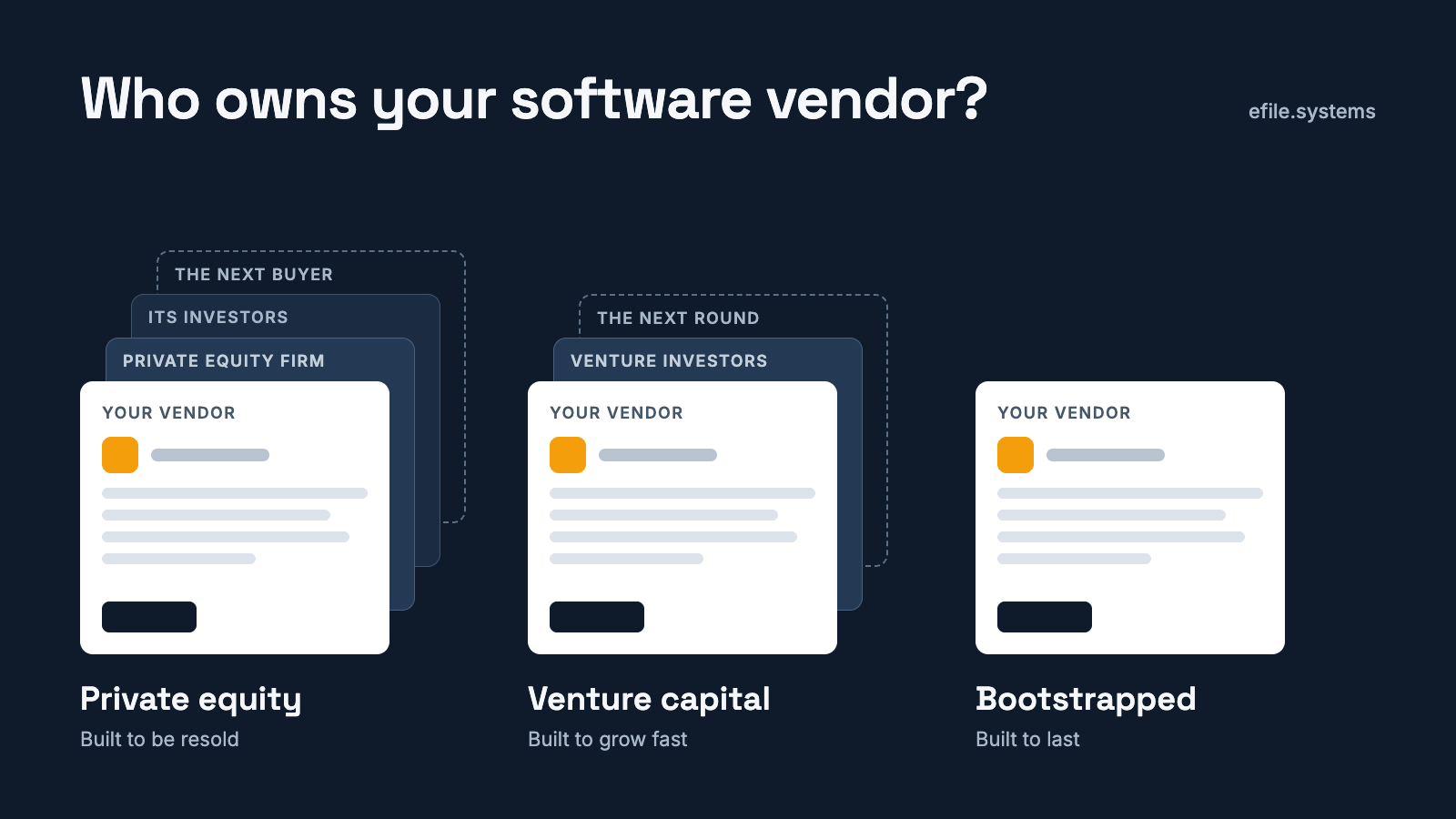
Private equity, venture capital or bootstrapped: who owns your software vendor shapes your price, your support and the product for the whole contract. Here is how each model works, and seven questions to ask before you sign.
November 27, 2026 • Christian Ott
When an agency evaluates software, it checks features, price and references. It almost never checks who owns the vendor. That is a gap, because the owners set the goals the company works toward for the whole length of your contract.
Government software companies come in three main kinds: owned by private equity, backed by venture capital, or bootstrapped. This post explains how each one works, what it is good at and where it can go wrong. We name companies as examples. What we say about them comes from news reports and the companies' own announcements. Being named here is not a criticism.
We should say up front that eFile is a bootstrapped small business. We think that model serves agencies well, and you should weigh what follows with that in mind.
Why ownership matters to an agency
A software contract in local government often runs three to five years, and most agencies renew at least once. Moving filers, records and staff to a new system is hard work. You will probably live with your vendor for a long time.
Over that time, the features you saw in the demo matter less than what the company is trying to achieve. A company that must be resold at a profit behaves differently from one that must triple its revenue. Both behave differently from one whose owners simply want to keep their customers.
Other models exist. Tyler Technologies is publicly traded, and OpenGov is now majority-owned by Cox Enterprises, a family-owned corporation. The three below are the ones a clerk's office meets most often.
Private equity: built to be resold
A private equity firm raises a fund from pension plans and other large investors. It buys companies with that fund, often adding borrowed money, and aims to sell each one for more than it paid. The return comes from growing the company's profit before that sale.
In government software, private equity owners often grow a company by buying its competitors and combining them. This is called a roll-up.
Examples
- Granicus. Vista Equity Partners took a majority stake in 2016. In 2018 Granicus acquired SouthTech Systems, a major player in California that had built records and disclosure software for county clerks since 1994. Harvest Partners joined as an investor in 2020, and Granicus went on to acquire Bang the Table, OpenCities and GovQA in 2021 and Rock Solid in 2022. In March 2025, Reuters reported that the owners were exploring a sale at about $4 billion.
- CivicPlus. Its founder held control until 2021, when Insight Partners bought a majority stake for $290 million. A few months later CivicPlus acquired Municode, which hosts the codes of nearly 4,000 local governments.
- eScribe. Founded in Markham, Ontario in 2007. In June 2021 JMI Equity invested $100 million in Passageways, the parent company of the board software OnBoard. Two months later Passageways acquired eScribe.
- Diligent, maker of BoardDocs, iCompass and Diligent Community. Insight Partners took the company private in 2016. Clearlake invested in 2018 and Blackstone in 2020. In November 2024, Reuters reported that the three owners were exploring a sale at nearly $7 billion.
- NEOGOV. Warburg Pincus invested in 2016 and Carlyle in 2021. In July 2025 they agreed to sell the company to EQT and CPP Investments, at a value Reuters put above $3 billion.
What you gain
- Scale and staying power. These companies serve thousands of agencies and rarely disappear.
- A broad suite. One vendor and one contract can cover many functions.
- Resources. Large implementation teams, mature security programs and professional management.
What to watch
- Price. Profit has to grow before the next sale. The most direct ways to grow it are to raise prices at renewal and to cut costs.
- Support. Support earns no revenue, so it is a natural place to save. That can mean tiered plans, outsourced help desks or a push to self-service.
- People. One pattern we have seen: after an acquisition, staff from the acquired company are let go. The people who knew the product and knew your agency are gone, and support gets harder because their knowledge left with them.
- Consolidation. After a roll-up, one company may own two or three products that do the same job. Eventually it picks one, and customers on the others are asked to migrate. Diligent, for example, has been moving BoardDocs customers to its newer Diligent Community platform.
- The next owner. Granicus, CivicPlus, Diligent and NEOGOV have each taken on new owners or major investors at least twice since 2016. Whoever you sign with may not be who you renew with.
The clearest public example comes from fire department software. In December 2025 the New York Times reported that ESO Solutions, backed by Vista Equity Partners, had acquired a records system used by volunteer fire departments and planned to shut it down. One Connecticut department was offered a replacement that would raise its cost from $795 a year to more than $5,000. In January 2026 two U.S. senators asked the Justice Department and the FTC to investigate.
That is one company in one market. It does not tell you how any other vendor will behave. It does show how the incentives can play out for a small public agency.
Venture capital: built to grow fast
Venture investors fund young companies that spend more than they earn. They expect most of their bets to fail and a few to grow very large, so they push every company to grow as fast as it can. A venture-backed vendor has to raise a new round every couple of years, and it gets that round only by showing rapid growth.
The odds are well studied. Harvard Business School's Shikhar Ghosh looked at 2,000 venture-backed companies and found in 2012 that about 75% never returned their investors' money. Thirty to forty percent were liquidated with a total loss. The study is old and its definition of failure is broad, but the direction is not in dispute.
Examples
- OpenGov, the success case. It raised at least $178 million from investors including Andreessen Horowitz, 8VC and Emerson Collective. In February 2024 Cox Enterprises bought a majority at a $1.8 billion valuation, and the venture investors exited.
- GovWell, a current startup. Founded in 2023, it sells permitting and licensing software to more than 130 municipalities and counties. It raised a $25 million Series A in May 2026, led by Insight Partners.
- Neighborly, the other outcome. It raised venture money to help cities sell municipal bonds online, and cities including Cambridge, Massachusetts used it. In 2019 it shifted to broadband. That October it told employees it could not pay them after a funding round fell through.
- UrbanLeap, another shutdown. The Silicon Valley procurement startup raised $4.2 million and said 35 municipalities used its software. It was a Gov Tech 100 company and had recently announced a partnership with CentralSquare when it closed in late 2022. Its founders wrote that shutting down is a failure.
What you gain
- New technology. The product was built recently, without decades of legacy code.
- Speed. Features ship quickly, and early customers get real influence over the roadmap.
- Price. Investor money often pays for low introductory pricing.
What to watch
- Runway. The company depends on its next funding round. If the round does not come, layoffs or a shutdown can follow quickly.
- Growth pressure. New money goes to sales first. Government buys slowly, which is hard on a company that has promised investors fast growth.
- Pivots. If your product line is not growing fast enough, the company may move its attention to a different market.
- The exit. Even success ends in a sale or an IPO. The buyer may be one of the consolidators from the previous section, and then that section applies to you.
- Introductory pricing. A price subsidized by investors has to rise once the company needs to show profit.
Bootstrapped: built to last, within limits
A bootstrapped company has no outside investors. The owners pay for growth out of revenue, which means out of what customers pay. The owners usually work in the business every day.
Bootstrapped vendors tend to be small, so the list of well-known names is short. One is NetFile, the long-established leader in California campaign finance and Form 700 filing. It was founded in 1998, is privately held and, as far as we know, has never taken outside investment. We compete with NetFile every week, and on ownership we sit on the same side of this line. eFile is the other example we know best.
What you gain
- One group to answer to. There is no fund deadline, no buyout debt and no growth target set by investors. The only people the company has to satisfy are its customers.
- Predictable pricing. The price has to cover costs and a fair profit. It does not have to produce a multiple for a fund.
- Support as survival. A small vendor that loses customers has no investor to cover the gap, so keeping customers happy is the business plan.
- Access. You can reach the people who make decisions, often the owner.
- A steady product. Nobody is merging your system into a suite to prepare for a sale.
What to watch
- Team size. Fewer people means less slack when several agencies need help at once.
- Key people. If critical knowledge sits in just one head, an illness or a departure is a real risk.
- Scope. AI tools now let a small team build and ship at a pace that used to take a large one, so this gap is closing fast. A bootstrapped vendor will still cover fewer departments than a suite assembled from a dozen acquisitions.
- Paperwork. Very high insurance limits, audited financials or a very large rollout can be hard for a small firm.
- A future sale. Founders retire and offers arrive. CivicPlus's founder told his local paper he was approached by investors almost weekly before he sold a majority in 2021. A bootstrapped vendor today may not be one in five years.
Seven questions to ask any vendor
- Who owns your company, and who holds the majority? A vendor that is comfortable with its ownership answers in one sentence.
- Has ownership changed in the last five years? Is a sale planned or being explored? Past changes tell you how long owners tend to stay.
- Are you profitable? If not, how many months of cash do you have? A company that loses money depends on someone else's patience.
- What have renewal increases been for agencies our size over the last three years? Will you cap them in the contract? A cap in writing is worth more than a promise in a demo.
- Who answers our support requests? Are they your employees, and what response times will you put in writing? Ask to speak with the support team before you sign.
- If you are acquired or shut down, what happens to our contract, our price and our data? Ask for the right to export all your data in a standard format and the right to leave after a change of control.
- How many people can maintain and support this product, and what is your plan if a key person leaves? This one is aimed at small vendors like us.
You can check many of the answers yourself. Read the vendor's About and press pages, and search the news for its funding rounds and acquisitions. Then ask the vendor to answer all seven in writing. Many of these contracts fall below bid thresholds, so there may be no RFP to put them in. An email reply or a page attached to the quote is enough.
Our own answers
It would be unfair to hand you that list and not answer it ourselves.
- Ownership. eFile is made by Electronic Filing Systems, the trade name of Pasadena Consulting Group LLC. We are owned by the people who run the company, with no private equity or venture capital investors.
- Changes. One change in six years. PCG was founded by Christian Ott and Casey Meakin. Casey left the company at the end of 2024. Alexander Buitron joined as a new managing member on January 1, 2025. This change has had no impact on how eFile operates and supports and serves its customers. Alex and Christian plan to operate eFile for decades to come. No sale is planned or considered.
- Profit. eFile is profitable.
- Renewals. We typically guarantee pricing for at least three years and then adjust for inflation.
- Support. Our support team is based in California. The first response from a person comes within 30 minutes. Our team includes a municipal clerk (MPA, MMC).
- Acquisition or shutdown. Your data stays yours, and you can get an export of all of it at any time.
- Team and continuity. Our team is seven people, and no part of eFile depends on just one of them. Our infrastructure is defined in code, at least two people can run every part of the service, and our controls are independently audited each year under SOC 2 Type II. A founder's departure at the end of 2024 already tested this, and service and support continued without interruption. We are a California-certified small business.
We are small, and some agencies need things only a large vendor can provide. If that is you, we hope this post still helps you ask better questions. And if a vendor will not tell you who owns it, you have learned something useful anyway.